Panel: Tackling The Oft-Dreaded Negotiation

Leave a comment
Work

This guy and his enormous hair took part in a session put together by The Writer’s Co-op (listen to their podcast!) and Study Hall (join their community!) to discuss negotiation—one of the most terrifying things there is in the world of freelancing.

I know the concept carries a lot of anxiety and baggage for people, but my experience—as a freelance writer, an editor, publisher and business owner—I find the mystique around negotiating a little odd. Yes, there are conversations about what work is worth, tweaks happen, sometimes things don’t work out. It’s just how businesses work. And it’s a lot more ordinary than people think.

(Or, to put it another way: contract negotiation isn’t a battle or even a game to me, it’s the moment that sets the table for the real work that you want to happen—the work that you do get enjoyment and satisfaction from. And if you begin a project by going to war with each other, I suspect the collaboration is going to be less successful. I realize not everybody feels this way.)

The other participants (Jenni Gritters, Wudan Yan, Kyle Chayka, Evan Kleekamp and Sarah Gilman) were more lucid and practical than me, I think, but I was glad to be part of it.

The takeaways I thought were most important:
—The best way to get things you want is to ask for them.
—There are many things other than your rate that can be negotiated.
—Decide what things are important to you and be prepared to walk away if you can’t get them.
—Talk to each other! Preferably on the phone!

On reflection I am, I suppose, a very lenient editor who has been lucky to not work (or not build) places that use contracts as weapons. I see my job as trying to get the best material in front of readers while channeling as much money as possible to writers; I don’t mind “stupid” questions; I bear few grudges. If that changes, it’s probably time to stop.

Here’s the recording.

Taking time

Leave a comment
Workbook

“Digital computers are synonymous in the popular mind with precision processing of information. However, when it comes to the basic information processing task of keeping time, they often perform worse than expected. To see how bad computers can be, consider some things that are better at keeping time. The gold standard in timekeeping is the sundial, which is a perfect analog timekeeper. However, sundials are not very practical and are not used to keep time on computer networks. The U.S. government, for instance, often needs to run its computer networks at night or on cloudy days.”
—How Many Seconds in a Second? Michael Hsieh and Doug Wood, FDD

Pandemic parenting

Leave a comment
Uncategorized

Anne Helen Petersen’s latest words resonated with me:

I am not a parent. I am, however, a person who hears and sympathizes with so many of the struggles of managing to work and parent right now, and as Chloe Cooney put it all the way back in April, “the parents are not okay.” Not the parents who are essential workers. Not the parents who are taking care of infants, or toddlers, or elementary school age kids who desperately miss their friends, or even teens. Not the parents who are trying to figure out what to do about school. Not the parents who are trying to figure out if it’s okay to use their own parents as caregivers. None of the parents are okay.

The pandemic has been hard on everyone, in almost every way imaginable, and often in the most tragic manner. But the impossible triad of adulthood, parenting and work is the one that’s really had me under its thumb.

Taking action

Leave a comment
Uncategorized

They talk about living your values, of walking the walk. John Lewis did it, figuratively and literally.

This morning I heard a Republican on the radio lauding Lewis for a life spent in service. The speaker noted, of course, Lewis’s leadership in civil rights, and specifically pointed out his dedication to non-violent protest and civil discourse. Given the moment, it was almost too easy to read between the lines, to catch a whiff of the subtext cast by Black Lives Matter. What they didn’t say, what they never really say, is that non-violent protest, that being civil, is not the same as staying quiet, and it is not the same as not acting.

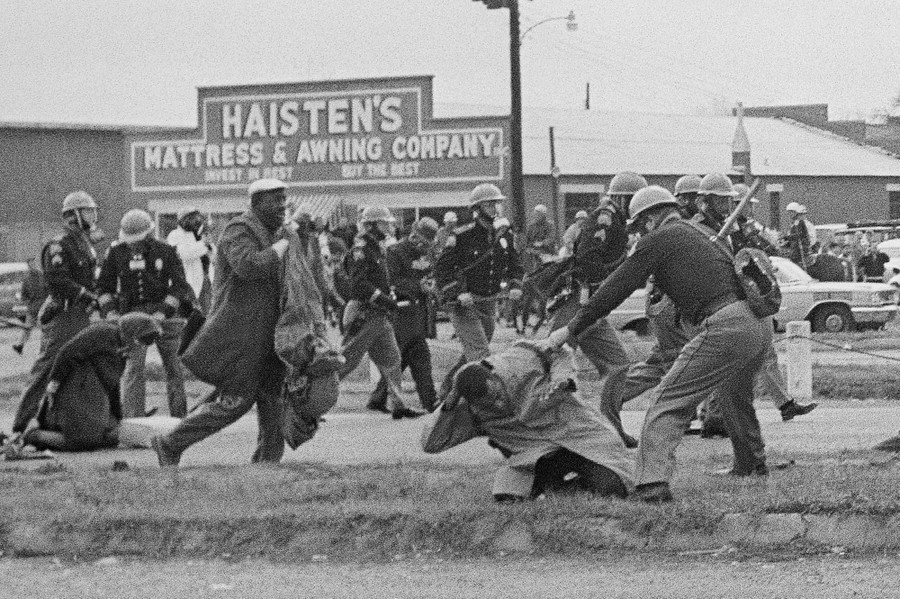
A few years ago, when I read Raymond Arsenault’s Freedom Riders, it became extremely clear to me how direct action operated during the civil rights movement. Speaking out against injustice—riding the bus knowing that it would lead to confrontation, of marching in the face of threats of police brutality—exposed the apparatus of suppression.

Direct action assumed, for the most part, that violence would occur, but that it would be driven by the police or the white community; the system’s immune responding the only way it knows how. True, the protesters were largely non-violent; that doesn’t mean the system’s response was peaceful. Look at Lewis, in the front of the photograph, being beaten by a state trooper while on a voting march in 1965.

§

I don’t want to write about The Letter, but seeing the tributes from my friends who were lucky enough to meet or know John Lewis, or just to be able to tell him what his work meant to them, it reminded me of the same. Somebody can call for civility, for discourse, for more speech, and they can honestly mean it. But being civil doesn’t mean doing nothing when you see somebody being hurt, and sometimes more speech requires protest; it requires direct action.

§

We all see our lives and experiences through a lens. It’s easy to see yourself and your decisions on the right side of history, like our Republican friend did. But it’s always worth asking yourself if you’re the protester or the system.

§

I know which side Lewis was on, and I know that it’s 59 years since he rode the bus. Fifty nine years, and we’re still marching.

Rest in power.

Week 28, 2020

comment 1
weeknotes

BLESSED RELIEF came as I prepared to take a week offline to get my head back But coming on the back of two short weeks, it was a headache to get everything done that I could—so that week is this week, if you follow. Still, I managed to finish a short novel: based on John Lanchester’s recent praise of the entirety of Georges Simenon’s Maigret series, I started at the beginning to see what he enjoys so much. More to come.

§

My stories this week: Magazine stories that will appear in the next couple of months, so just a couple of shorts really: O’Neill on the “invisible god” hacker and Charlotte Jee on the reasons that digital contact tracing apps in Australia and France have produced so few notifications.

§

Things my friends have made: Alok Jha on pandemic prevention • Annalee Newitz takes to the pages of the Chronicle to look at the future of Muni.

§

Notebook: Lockwood on lockdown is worth reveling in • I hadn’t heard of Atari Democrats before • And I hope I never hear about Quibi ever again. • Enjoyed The Loss of Public Goods to Big Tech • Not a fan of virtual reality? Imagine if you had to wear this get-up • Lovely football lingo from around the world.

Larissa MacFarquhar on the Falkland Islands

comment 1
Media

I harbor a mild but ongoing fascination with the wild, out of the way places that British people have decided they should inhabit; the far-flung islands, the unnavigable boggy moors, the places where there’s one house every few miles and people choose lonely, hard existence for whatever reason. St Helena, Dartmoor, the Hebrides, Pitcairn and so on.

Larissa MacFarquhar—one of the New Yorker writers I most enjoy—crystallizes what draws people to one of these places, the Falkland Islands, and happened when modern life arrived.

The manager might be the only local authority—he conducted marriages and assigned punishments; it was said that not long before Tim Blake came to Hill Cove a man there was fired for whistling.

Because drinking could be a problem, especially in winter, when there wasn’t much to do, the farm store rationed sales of alcohol. When a man grew too old for farmwork, he had to retire, which meant that he had to leave his house on the farm and move to Stanley.

But there was little for retired men to do in Stanley except go to the pub, and they often died soon afterward.

Photograph by Maroesjka Lavigne for The New Yorker.

The piece plays against convention, really. It has an arc, but it doesn’t really resolve. The people in the story only talk through her rather than through quotation or dialogue, aside from the odd moment when they are given space to speak in block quotes.

In fact there isn’t really a central character in the story, aside from the islands themselves, just a string of isolated stories that represent different strands of what has happened in the islands.

But I think I particularly enjoyed how carefully it avoided becoming a story about isolation. Obviously the pandemic creates a new window to view separation and distance—one that is easy to reflect back to the reader. She manages, though, to avoid hammering home the comparisons and finds a place for the story in the Now without ever giving in to it entirely.

Quietly powerful.