Starting from scratch

Leave a comment
Work

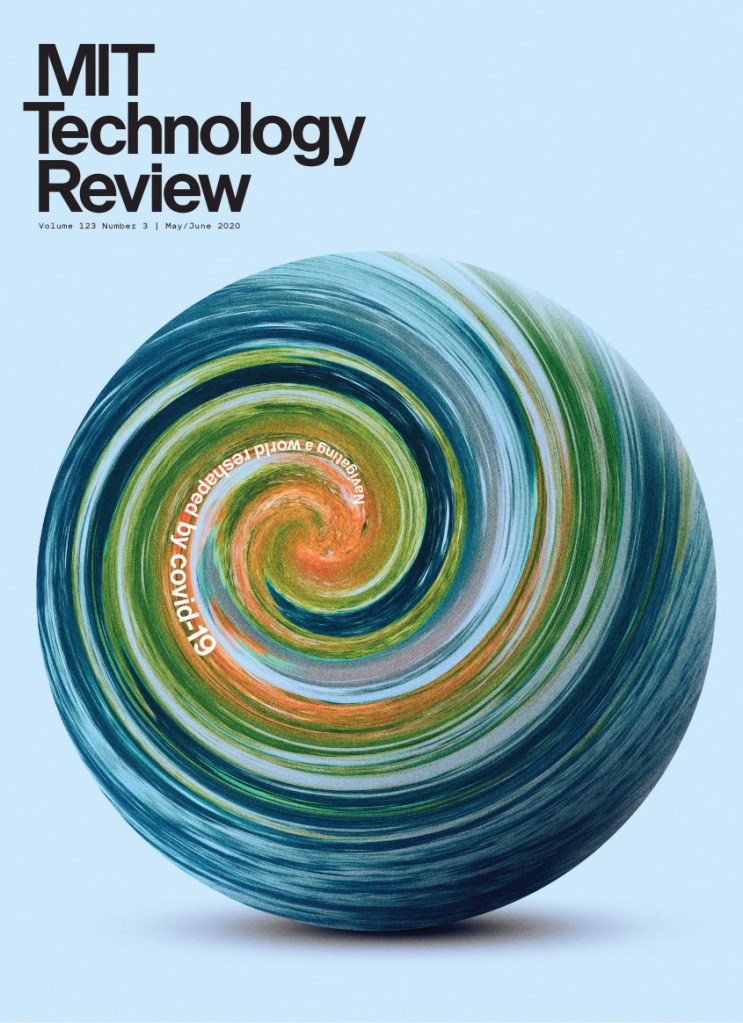
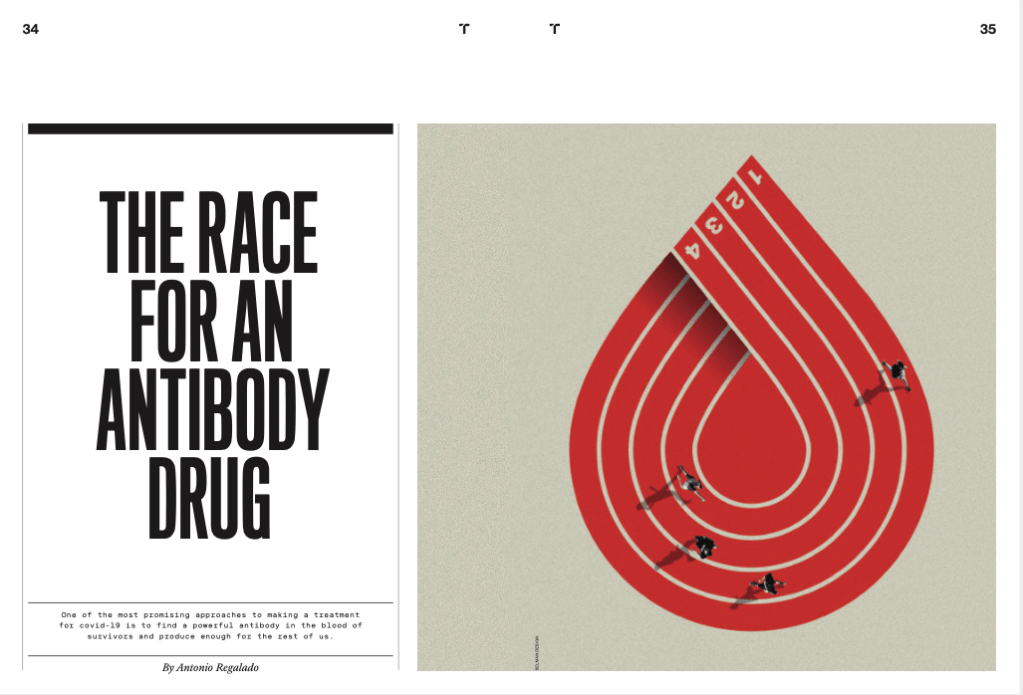
In March, a couple of weeks before we were due to ship the May/June issue of Technology Review, something became extremely clear: we needed to throw it away.

We’d already cleared a portion of the magazine for coronavirus coverage, but as the pandemic kicked in, everything seemed irrelevant. Nobody would want to read what we’d prepared for them, at least not now, not when all they could think of was covid-19. Everybody got behind the idea quickly, and without complaint. They all knew it was the right thing to do.

So, in a couple of weeks—rather than the usual couple of months—we built a new magazine.

New stories assigned, reported, written, edited, art directed and published. It was a huge team effort all round and actually turned out to be both deeper and more optimistic than I had first imagined. I also edited a ton of stories, so I just want to give a shout out to all of them. There are others in the magazine too. You should look!

I ended up exhausted and proud. As I said to everybody: “Fantastic work. very proud of everybody and of the lineup we arrived at. Now, let’s never do that again.”

How we get to normal
A blueprint for living in a world with covid-19
Gideon Lichfield

How to manage a pandemic
Why some countries have fared far better in the battle against covid-19 than others—and what we can learn from them.
James Crabtree

Helping hands
How scientists, researchers, and engineers are organizing volunteer efforts to fight the pandemic.
Karen Hao

Repurposing drugs might help fight this pandemic
And they could even help with the next one.
Wudan Yan

The trace race
Even with a national government asleep at the wheel, one Indian state showed the world the right way to tackle coronavirus.
Sonia Faleiro

Vaxx the vote
America might survive coronavirus. But will the election?
Patrick Howell O’Neill

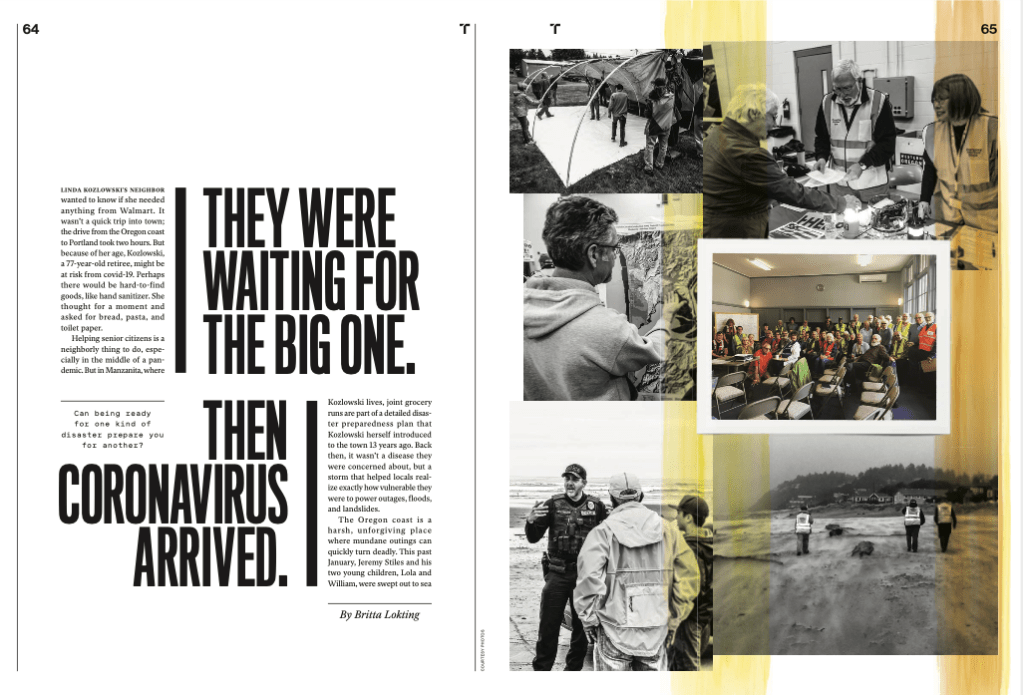
They were waiting for the Big One. Then coronavirus arrived.
Can being ready for one kind of disaster prepare you for another?
Britta Lokting

Together alone
What the sea taught me about a life of isolation.
Rose George

The stress test
There’s a boom in mental health apps and teletherapy. But are they good enough?
Tanya Basu

Leave a comment
Link

“The protests demanding that states “reopen” after all are protests demanding that working people head back into jobs that risk their health. The now-infamous “I Want a Haircut!” sign brandished by a Wisconsin woman underlined the point: These people aren’t simply protesting curtailments of their own movement. They are protesting a lack of people to serve them. They are demanding other people get back to work. And when we look at that sign and flinch at it, we are recognizing that we have no right to make that demand. That everyone should have the right to say no. Call it, perhaps, a right not to work.”

Sarah Jaffe in ‘The Post-Pandemic Future of Work’, The New Republic

BRB24: How to handle an apocalypse

Leave a comment
Newsletter

It’s not panic, exactly. It’s almostpanic, a tremor of a fear that is beginning to surge but is not yet quite established. It’s hearing an echo, a whisper in a nervous crowd. One person coughs on the train, everyone stares. Reactions shaped by a lifetime of narratives about the End—the disaster that changes everything, the disease that triggers a cataclysm. We know how this story goes, right?

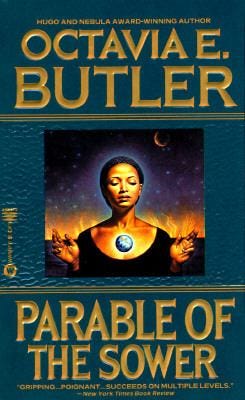
A few weeks ago, before this became this, I picked up Octavia Butler’s Parable of the Sower, a tight and expressive science fiction classic that was new ground to me. The disaster in the book is climate change, and the response causes a cataclysm. It’s a lean, careful story that is proud of itself but never showy: this apocalypse is built with hints rather than eruptions. 

In Butler’s universe, one community gathers to save itself then—when everything is taken away—a new group gathers to worship. Their God is change, an idea which feels new to those inside the story but is utterly familiar; an uncaring, unsparing power bigger than all of us. Change is constant and bleak and unrelenting, but it’s also a river you can ride. Even if you lose yourself to it, you aren’t necessarily lost. 

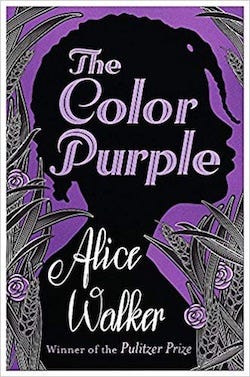
Just before Sower, I’d read another book about God: Alice Walker’s The Color Purple. This time it wasn’t new—I’ve read it before, although, as I worked it through I honestly couldn’t remember the first time around.

It’s a parable of its own, really. A series of letters to God, although not quite the same God. Change happens to Celie, again and again, a series of quiet cataclysms that the outside world chooses to ignore. And then, when change seems like it’s , circumstances shift and she gets the chance to be a kind of change all of her own. The God of The Color Purple seems very different from Sower, but perhaps it’s also exactly the same: a force that keeps acting on everyone because it can’t do anything else. 

And in between them both, I suppose I saw a lesson. Our reaction to what happens is as important as what it is; the way we stare into the disaster that shapes what it can do to us. These aren’t stories about apocalypse. They are about survival. They need you to have made it out in order to recount what happened. And that, that is how this story always goes.

Every week or so I write about a book I’ve read, as well as throw in some extra links. To get these reviews as soon as they come out, sign up at brb.substack.com.

Malcolm Harris on fossil fuel’s plan to profit from climate change

Leave a comment
Link

“Last fall, the Shell Scenarios team — as in Royal Dutch Shell, one of the biggest oil companies in the world — offered me £2,000 in exchange for a 15-minute talk and my participation in a group exercise. Its internal corporate think tank was holding a daylong conference about how generational change would affect the hopefulness projected in what the company calls the “Sky Scenario,” which it describes as “a technically possible but challenging pathway for society to achieve the goals of the Paris Agreement.” I’m not a climate expert, but apparently I qualify as a generational whisperer, at least to Shell, and to talk to me about global warming, the giant energy conglomerate wanted to fly me to London from Philadelphia, business class. I warned them that I couldn’t keep their money and asked if I’d need to sign an NDA. When they said no, I saw an opportunity to report on the oil company, undercover while in plain sight, without technically lying to anyone. It was too good to pass up. I said yes, then I emailed my editor.” (Malcolm Harris, New York)

BRB23: You always know, even when you don’t

Leave a comment
Newsletter

The thing about being poor is that you never quite realize it until something happens—a moment of shame that puts you in your place, or an embarrassment that flushes your truth out for everyone to see. 

The thing about being really poor, though, is that you realize it all the time.

We veered between different points along the spectrum, traveling one way and another driven by the ups and downs of an economy nobody really understood and that was entirely out of our control. At its best, we were upwardly mobile with eyes on the future. At its worst we were bankrupt and homeless. I think a lot now about how my parents, who were just kids themselves really, made their way through. Life on the estates was good but never simple, although I never quite understood what was happening until I was older—we were too proud, maybe, or I was just too unaware of what life outside looked like to make a comparison. It was only when I went to university that I really understood I was poor.

In The End of Eddy, a memoir by Eduoard Louis, he knows it from the start. Eddy’s family is angry, ground down by alcoholism and disability. He’s the youngest of a brood growing up with nothing in a world where most people have everything (Louis grew up in the 90s and 2000s: this is not ancient history.)

When the book came out, it got the same kind of dewy-eyed “staggering insight into rural poverty” notices—a Hillbilly Elegy for the France of Le Pen and, later, gilet jaunes.

But this book isn’t the tale of France; it’s not even not the story of a dirt poor, rural French family. It’s the tale of the gay son who needs to escape his life to find something different. 

The End of Eddy has its own strange momentum. The writing is raw in places, although more in the sense of being unfinished than heartfelt. It’s direct; horrifying at times, but never quite beautiful. Eddy is full of rage and conflict and betrayal, and I liked that I didn’t find him likeable, which feels perverse to write down. The thing is, nobody is a hero here, although maybe when Eddy describes discovering what the world wants to do to him—emotionally, sexually, physically—you are at least on his side. His poverty is not a surprise, but it’s what that lets the world do to him that crushes you.

Every week or so I write about a book I’ve read, as well as throw in some extra links. To get these reviews as soon as they come out, sign up at brb.substack.com.

Life inside the book-to-film complex

Leave a comment
Media

Very interested to read this James Pogue takedown of the explosion in non-fiction which is made to be sold to Hollywood (or whatever we call the Netflix-Apple-Hulu-Amazon-Hollywood machine these days.) While it’s somewhat flawed, possibly unfair to a number of authors, and more than a little self-serving, the essay does do a good job laying out an argument about a very specific kind of journalistic product.

“The book-to-film complex is bolstered by two imperatives that now govern our nonfiction almost without exception: foreground story as an ultimate good, ahead of deep personal insight, literary style, investigative reporting, or almost any other consideration that goes into the shaping of written work; and do not question too closely the aristocracy of tech and capital that looms over us, the same people who subsidize the system that produces America’s writing.”

Most of all I am fascinated by the lack of true success this entire genre, which exploded when the Atavist, Byliner, and Kindle Singles all arrived on the scene. (We launched Matter not long afterwards.)

As Pogue notes: “Of all the stories Epic has placed since its founding in 2013, only one—bought, again, by Apple—has been filmed.”

The fact that while selling options and rights has gone from being a profitable but occasional sideline for a small number of writers and turned into the core business proposition of a larger group, almost all of this money is being spent to create nothing. It’s just speculative cash, defensive investment, or an attempt by studios to mitigate risk that writers and publishers may temporarily benefit from.

I recognize a lot of what he says here. We saw a lot of these issues inside Matter, and saw the results. In the first generations of the publication, we struggled with Amazon precisely because we favored argument or investigation over narrative. We loved a good story, but wanted a deeper insight. (I like to think this was evidenced by the fact that we won a number of investigative journalism awards and reporting prizes.)

Our stories chimed with readers, but they were harder to get past the gatekeepers. Rights inquiries were rare, although we could have put more into chasing them I suppose. (In Matter’s later lifetimes, where I had less involvement, we were staring right down the throat of this relationship.)

I’m not going to pretend that everything we did was worthy journalism of the sort that Pogue seems to dream about. Most of it wasn’t lofty. But I think it’s a good explanation of why I want the stories I work on to—at the very least—live in the world of consequences; to have a point of view.