Should we stop political journalists covering coronavirus? (Dan Froomkin, Presswatch)
Malcolm Harris on fossil fuel’s plan to profit from climate change

“Last fall, the Shell Scenarios team — as in Royal Dutch Shell, one of the biggest oil companies in the world — offered me £2,000 in exchange for a 15-minute talk and my participation in a group exercise. Its internal corporate think tank was holding a daylong conference about how generational change would affect the hopefulness projected in what the company calls the “Sky Scenario,” which it describes as “a technically possible but challenging pathway for society to achieve the goals of the Paris Agreement.” I’m not a climate expert, but apparently I qualify as a generational whisperer, at least to Shell, and to talk to me about global warming, the giant energy conglomerate wanted to fly me to London from Philadelphia, business class. I warned them that I couldn’t keep their money and asked if I’d need to sign an NDA. When they said no, I saw an opportunity to report on the oil company, undercover while in plain sight, without technically lying to anyone. It was too good to pass up. I said yes, then I emailed my editor.” (Malcolm Harris, New York)
BRB23: You always know, even when you don’t
The thing about being poor is that you never quite realize it until something happens—a moment of shame that puts you in your place, or an embarrassment that flushes your truth out for everyone to see.
The thing about being really poor, though, is that you realize it all the time.
We veered between different points along the spectrum, traveling one way and another driven by the ups and downs of an economy nobody really understood and that was entirely out of our control. At its best, we were upwardly mobile with eyes on the future. At its worst we were bankrupt and homeless. I think a lot now about how my parents, who were just kids themselves really, made their way through. Life on the estates was good but never simple, although I never quite understood what was happening until I was older—we were too proud, maybe, or I was just too unaware of what life outside looked like to make a comparison. It was only when I went to university that I really understood I was poor.
In The End of Eddy, a memoir by Eduoard Louis, he knows it from the start. Eddy’s family is angry, ground down by alcoholism and disability. He’s the youngest of a brood growing up with nothing in a world where most people have everything (Louis grew up in the 90s and 2000s: this is not ancient history.)
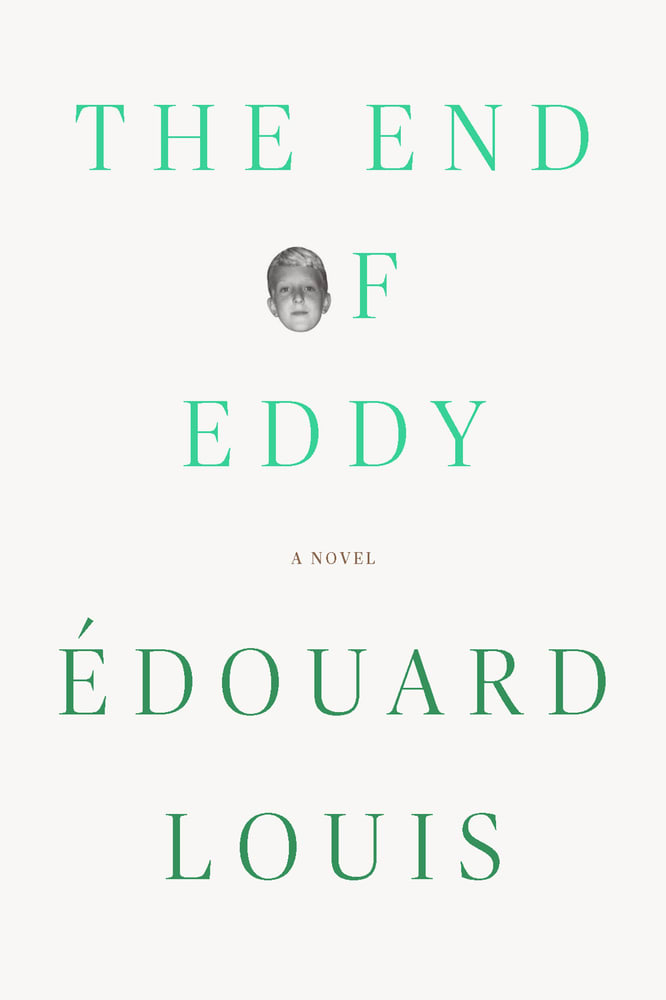
When the book came out, it got the same kind of dewy-eyed “staggering insight into rural poverty” notices—a Hillbilly Elegy for the France of Le Pen and, later, gilet jaunes.
But this book isn’t the tale of France; it’s not even not the story of a dirt poor, rural French family. It’s the tale of the gay son who needs to escape his life to find something different.
The End of Eddy has its own strange momentum. The writing is raw in places, although more in the sense of being unfinished than heartfelt. It’s direct; horrifying at times, but never quite beautiful. Eddy is full of rage and conflict and betrayal, and I liked that I didn’t find him likeable, which feels perverse to write down. The thing is, nobody is a hero here, although maybe when Eddy describes discovering what the world wants to do to him—emotionally, sexually, physically—you are at least on his side. His poverty is not a surprise, but it’s what that lets the world do to him that crushes you.
Every week or so I write about a book I’ve read, as well as throw in some extra links. To get these reviews as soon as they come out, sign up at brb.substack.com.
Life inside the book-to-film complex
Very interested to read this James Pogue takedown of the explosion in non-fiction which is made to be sold to Hollywood (or whatever we call the Netflix-Apple-Hulu-Amazon-Hollywood machine these days.) While it’s somewhat flawed, possibly unfair to a number of authors, and more than a little self-serving, the essay does do a good job laying out an argument about a very specific kind of journalistic product.
“The book-to-film complex is bolstered by two imperatives that now govern our nonfiction almost without exception: foreground story as an ultimate good, ahead of deep personal insight, literary style, investigative reporting, or almost any other consideration that goes into the shaping of written work; and do not question too closely the aristocracy of tech and capital that looms over us, the same people who subsidize the system that produces America’s writing.”
Most of all I am fascinated by the lack of true success this entire genre, which exploded when the Atavist, Byliner, and Kindle Singles all arrived on the scene. (We launched Matter not long afterwards.)
As Pogue notes: “Of all the stories Epic has placed since its founding in 2013, only one—bought, again, by Apple—has been filmed.”
The fact that while selling options and rights has gone from being a profitable but occasional sideline for a small number of writers and turned into the core business proposition of a larger group, almost all of this money is being spent to create nothing. It’s just speculative cash, defensive investment, or an attempt by studios to mitigate risk that writers and publishers may temporarily benefit from.
I recognize a lot of what he says here. We saw a lot of these issues inside Matter, and saw the results. In the first generations of the publication, we struggled with Amazon precisely because we favored argument or investigation over narrative. We loved a good story, but wanted a deeper insight. (I like to think this was evidenced by the fact that we won a number of investigative journalism awards and reporting prizes.)
Our stories chimed with readers, but they were harder to get past the gatekeepers. Rights inquiries were rare, although we could have put more into chasing them I suppose. (In Matter’s later lifetimes, where I had less involvement, we were staring right down the throat of this relationship.)
I’m not going to pretend that everything we did was worthy journalism of the sort that Pogue seems to dream about. Most of it wasn’t lofty. But I think it’s a good explanation of why I want the stories I work on to—at the very least—live in the world of consequences; to have a point of view.
Out of copyright
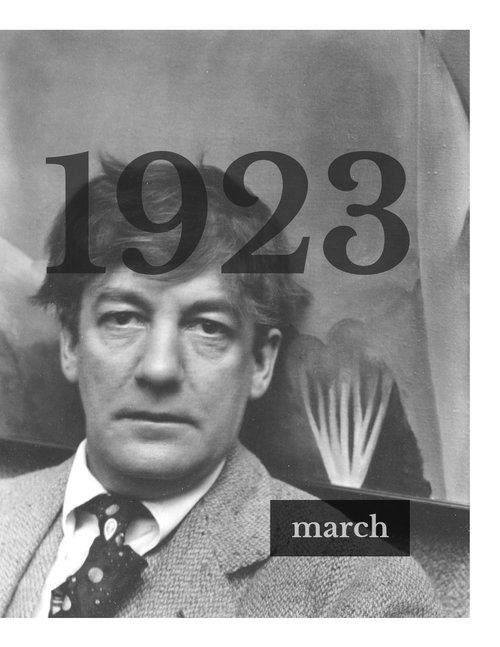
This has just come to my attention from last year: 1923, a project by Parker Higgins to create magazines from material that was entering the public domain. There were several hundred genuine print subscriptions available through the project’s Kickstarter (long gone) but downloadable online. I hope he made it to the end of the year—the archive stops in October.
The old internet
Katie Notopoulos gives a reasonable rundown of the web that used to exist before the 2010s (a wild and disintermediated place where independent creators had a chance to thrive) and the one that exists a decade later (centralized into a handful of aggregators and platforms that everyone is reliant on.)
The internet of the 2010s will be defined by social media’s role in the 2016 election, the rise of extremism, and the fallout from privacy scandals like Cambridge Analytica. But there’s another, more minor theme to the decade: the gradual dismantling and dissolution of an older internet culture.
Katie Notopoulos, The Old Internet Died And We Watched And Did Nothing
This purge comes in two forms: sites or services shutting down or transforming their business models. Despite the constant flurries of social startups (Vine! Snapchat! TikTok! Ello! Meerkat! Peach! Path! Yo!), when the dust was blown off the chisel, the 2010s revealed that the content you made — your photos, your writing, your texts, emails, and DMs — is almost exclusively in the hands of the biggest tech companies: Facebook, Google, Microsoft, Amazon, or Apple.
It’s a similar argument to that laid out in 2012 by Anil Dash in “The Web We Lost” and in 2015 by Hossein Derakhshan in “The Web We Have To Save”. There are, of course, many competing factors and questions that make this not a simple situation—wild, creative and independent for whom? Would accountability be any better with a billion tiny sites?—but it’s pretty easy to see the ills resulting from platform dominance.
At Medium, one of our earlier stated principles was that it would take a platform to beat a platform: but platforms didn’t have to be monsters, they could be a thousand times better and help independents flourish. The machinery was more Twitter than Blogger, but our hope was that it could be more Blogger than Twitter. I was naive to believe that the specific case could be true—Medium’s slow shift towards control looks like a planned jettisoning of those principles from here—but I do think there’s something in there in the general sense. Imagine all the roads the web didn’t take.
BRB 22: Definitely up there with 97 and 08
A man sits, hands hovering over a keyboard, puffy encircled eyes turned to a square of sky he witnesses through the window and between the rooftops. Over there, his kid watches The Simpsons. He’s really into The Simpsons right now. Over in the other direction, the kitchen is strewn with the debris of a Christmas season that has definitely been well spent, but is now definitely well spent. He recalls these twelve months that are crawling out of view. It’s been a big year, he thinks to himself, definitely up there with ninety-seven and oh-eight. If he was a character in a middle aged man’s novel, or just a different kind of middle aged man, he’d be ranking them all like an obsessive, and those years—this year—would all come pretty high up the list. Not quite at the top, but close.
He thinks about how his life has expanded, changed over these months. There is a new home on a new street that is not very far away from the old street. It has brought joy and a kind of peace, but also responsibilities, a duty of care, and a menagerie. This morning he has already checked on the fish in the pond, fed the cat, and fixed the fountain where the hummingbirds come to bathe every morning. Hummingbirds, for fuck’s sake.
Just last week—because he likes to fix broken things—they added a dog, a stray who arrived on the doorstep in the rain like an omen. She’s not fixed, but she is fed, and she is sitting next to him. He looks back up at the sky.
Now it’s time to write.

(image from Coffee Channel)
When this newsletter started, it was an attempt to keep track of books that had been read. A piece of memorializing, or an act of accounting, if you’re looking for that. Perhaps even, for the dramatic people in the back, a reckoning. Last year there were thirty distinct books. This year? Forty-nine close reads, probably with some room to add another before the fireworks pop.
Some were new, some were old. A mix of work and pleasure. Plenty were good, a couple were great, and a few were bad. Only a portion of them got reviewed. So as we see out 2019 and think about what it brought us, here’s every book completed, in the order they were finished.
Barbarian Days – William Finnegan
Less – Andrew Sean Greer
All The Light We Cannot See – Anthony Doerr
Arbitrary Stupid Goal – Tamara Shopsin
Lies My Teacher Told Me – James Loewen
We’re Doomed, Now What? – Roy Scranton
Too Much And Not The Mood – Durga Chew Bose
Life And Other Near Death Experiences – Camille Pagan
Infinite Detail – Tim Maughan
Silent Spring – Rachel Carson
Rabbit – Patricia Williams
On Tyranny – Tim Snyder
10:04 – Ben Lerner
Taking The Work Out of Networking – Karen Wickre
Triggering Town – Richard Hugo
Human Acts – Han Kang
Hunger – Roxane Gay
Ruined By Design – Mike Monteiro
Ghost Work – Mary Gray and Siddarth Sudi
The Smart Enough City – Ben Green
Electronic Colonialism – Tom McPhail
Drawdown – Paul Hawken
Six Degrees – Mark Lynas
Empty Planet – Darrell Bricker and John Ibbitson
Cixi – Jung Chang
Undaunted – Jackie Speier
A Song of Ice and Fire – GRR Martin
Good Prose – Tracy Kidder and Richard Todd
White Nights, Black Paradise – Sikivu Hutchinson
The View From Flyover Country – Sarah Kendzior
We Are Not Such Things – Justine van der Leun
Harry Potter And The Chamber Of Secrets – JK Rowling
The Future Of War – Lawrence Freedman
Interpreter of Maladies – Jhumpa Lahiri
How Everything Became War And The Military Became Everything – Rosa Brooks
Exit West – Mohsin Hamid
Heartland – Sarah Smarsh
Visions After Midnight – Clive James
Random Family – Adrienne Nicole Leblanc
This Will Only Hurt A Little – Busy Phillips
The Reality Game – Samuel Woolley
The Power And The Glory – Graham Greene
Lab Girl – Hope Jahren
Dept of Speculation – Jenny Offill
The End Of Eddy – Eduoard Louis
Unspeakable Things – Jess Lourey
The Story Behind – Emily Prokop
Burnout – Emily and Amelia Nagoski
Heat and Dust – Ruth Prawer Jhabvala
That’s about half men, half women. Mostly non-fiction of various kinds. Writers from America, mostly, an unsurprising portion of British, a smattering of others. Lots of immigrants, not many people of color. A couple in translation. There are plans for more expansive reading next year.
Now, to wrap up, some further reading.
A few stories I loved editing this year:
Alissa Greenberg on the quest for a new way of understanding wildfires
Anthony Swofford on the morality of high-tech war
Max Kim on corruption in South Korea’s nuclear industry
Eric Reidy on the people documenting Syrian war crimes
A few stories that stuck with me:
From Columbine to Parkland: Why we got the story wrong about mass shootings (Dave Cullen, the Guardian)
The Trauma Floor (Casey Newton, The Verge)
The Believer (Davey Rothbart, California Sunday)
All That Was Familiar (Abubakar Adam Ibrahim, Granta)
Hideous Men (E Jean Carroll, New York)
How Oxford Shaped Brexit—And Britain’s Next Prime Minister (Simon Kuper, Financial Times)
That’s it for now.
BRB
⌘
Every week or so I write about a book I’ve read. To get these reviews as soon as they come out, sign up at brb.substack.com.

