How should we feel about that?

Leave a comment
Media

Eyeballs on the clash of the real and the virtual this week with the news that a new Bourdain documentary features an AI-generated version of the man’s voice reading out emails he sent people (notably, I think, the audio appears to have been used in the trailer.) This NYer piece, featuring my colleague Karen Hao in quotable form, goes through some of the issues.

Creating a synthetic Bourdain voice-over seemed to me far less crass than, say, a C.G.I. Fred Astaire put to work selling vacuum cleaners in a Dirt Devil commercial, or a holographic Tupac Shakur performing alongside Snoop Dogg at Coachella, and far more trivial than the intentional blending of fiction and nonfiction in, for instance, Errol Morris’s “Thin Blue Line.”

[…]

At the same time, “deepfakes” and other computer-generated synthetic media have certain troubling connotations—political machinations, fake news, lies wearing the HD-rendered face of truth—and it is natural for viewers, and filmmakers, to question the boundaries of its responsible use. Neville’s offhand comment, in his interview with me, that “we can have a documentary-ethics panel about it later,” did not help assure people that he took these matters seriously.

Helen Rosner, The ethics of a deepfake Anthony Bourdain voice, The New Yorker

Which books do you truly love?

Leave a comment
Media

“I believe that the books and stories we fall in love with make us who we are, or, not to claim too much, the beloved tale becomes a part of the way in which we understand things and make judgments and choices in our daily lives. A book may cease to speak to us as we grow older, and our feeling for it will fade. Or we may suddenly, as our lives shape and hopefully increase our understanding, be able to appreciate a book we dismissed earlier; we may suddenly be able to hear its music, to be enraptured by its song.”

Salman Rushdie, Ask Yourself Which Books You Truly Love, New York Times

Getting inside somebody’s head

Leave a comment
Media

There’s something so intricate and mysterious about the whys of another person, wanting to understand what makes them tick, what made them what they are. It’s an instinct that’s so human. Biographies, documentaries, magazine profiles, obituaries are all part of this drive we have to get inside somebody else’s head.

One of my first jobs, as a researcher for the Royal Shakespeare Company, was to build dossiers on interesting and notable people that might make good patrons or ambassadors. It was somewhat uncomfortable (I once did a dossier on one of my college lecturers) but it was also endlessly interesting, trying to pin down the connections and actions and motivations that we could learn from.

That’s one reason I was fascinated by the launch last year of The Profile, a newsletter/media product focused entirely on the format of profiles about interesting people. Former Fortune journalist Polina Marinova wrote about what it’s like to launch a company during the pandemic, but I think this idea of disaggregating formats is incredibly intriguing. More than a year in, I’m interested to see where it is going to go.

The question behind all profiles and biographies, I suppose, is why do you want to know about this other person? Why do you need to know about them? What can you learn?

(Side note: The paranoid journalist in me is also fully terrified of profiles and biographies. What if you do all that work, if you talk to the people, and review the documents, and you still manage to miss the Thing? What if you write the Harvey Weinstein profile and miss the abuse? A few times in my career this moment feels like it has come close, but I think the answer is that you do everything you can to avoid a mistakes—but sometimes, yes, you will miss the thing, because if people hide themselves from those who are closest to them, you might not be able to see through it either.)

My subscription addiction

Leave a comment
Media

I consume a lot of media. I also pay for a lot of it.

When I started out in journalism, there was a massive shift taking place, driven by the web, towards free access. But it wasn’t just the web. During college I worked evenings as an intern at the newly-launched Metro; I then worked on free-to-access online news at the London Evening Standard and came up through The Guardian, which has long been an opponent of paywalls. Partly because of this, I used to be pretty strongly against paywalls on principle, but I’m certainly not a fundamentalist. Matter was a lean subscription play at first, although it shifted as ownership changed; Anxy was an expensive print-first product; Technology Review has a metered paywall.

Over the years I’ve built up a significant list of subscriptions to many publications and services and a few individuals. It’s now at least 50, probably significantly more: I started out making a full list of all my subs, but it was long and boring. And I’m pretty sure I missed a few off there, particularly small indy magazines.

These range from the pretty mainstream stuff like The New York Times and The Atlantic (neither of which need me as a subscriber, and have corners of problematic output) to the mid-range (I love my London Review of Books) to the small press and esoteric services: The Nib‘s wonderful comics; Sonia Weiser’s regular lists of freelance journalism opportunities.

I wanted to highlight a few that I would recommend that may be new to you.

The Browser I love this curated email roundup of great stories, and have been a subscriber for a few years now. I don’t read it every day, but I always find something worthwhile in there. Interestingly one of the few email newsletters that moved away from Substack, rather than towards it.

Logic One of my favorite subscribes of the past few years, this actually does come out of the Bay Area. It’s three years in or so, and I honestly have absolutely no idea how it’s doing, but it’s always thought-provoking and has a point of view.

Stack This has been absolutely one of the most rewarding subscriptions I have: a monthly surprise delivery of an independent magazine. They were very kind to Anxy in its earliest days, but each edition never fails to delight.

Getting yourself out of the way

Leave a comment
Media

I really enjoyed hearing the director and writer Adam McKay—who has made not-fiction movies like The Big Short, Vice, and a forthcoming Theranos movie, as well as entirely fictional comedies such as Anchorman—discussing creative process on the Longform podcast. It was a little exhilarating to hear him discuss the complexity of producing work in this moment, the feeling that happens when inspiration hits you, and his belief that there are a million ways to tell a story (and that the right way now might not be the same as the right way in a few years.)

One critical lesson, I think, was that when you make something great, it’s partly from you, but it’s bigger than that—it takes on a life of its own, and your job is often to just get yourself out of its way. Which captures, I think, why any of us make anything.

“Sometimes you do a project and then you look back and you’re like, Ah, shit. I let some of myself get in the way of that. It sucks, but it’s also a part of it. And there are so many times where you’re excited that the story did take off, the wind did catch the sail and it went off on its own. And that just feels so good that it far outweighs the times when you make a mistake, or let something go wrong, or too long, or hit the wrong tone. Which is going to happen. There’s no way around it. But those times when it all just catches perfectly—it’s just so exciting that you keep doing it.”

Revolutionary music

Leave a comment
Media

It’s become a kind of folksy, cheesey number over the years, but did you know that the Cat Stevens (AKA Yusuf) song “Father and Son” is actually about the Russian Revolution?

I was a little bit amazed to hear in a recent episode of Song Exploder how the song had started its life as part of a musical about the overthrow of the Tsar in 1917. It’s intended to be a conversation between a young man who wants to go and fight for the revolution, and his peasant feather who wants to stick with what he has worked for.

This isn’t a secret or anything. Here he is talking to GQ last year:

I was living in the West End and musicals were a big thing in my life. I got together with Nigel Hawthorne and we started writing this musical called Revolussia. Essentially, it was about Nicholas and Alexander, the last tsars of Russia, and against that there’s another story about this family in the farmland, in the country. And the father, of course, basically wants to keep things as they are, while the son is really inspired by the revolution. He wants to join. And so that’s the inspiration for that song. That’s why I’m able to represent both sides – though I feel that my preference, my emphasis, was on the son’s side, and the father’s arguments were not quite as strong as the son’s, which is interesting. Change is basically the theme of the song.

It obviously don’t change the universal nature of the song, but it did change it for me—suddenly music that had felt as warm and familiar as an old coat gained this new and surprising context.

(Also highly recommend the Netflix series if you haven’t already seen it.)

Desolate, playing the piano, and wailing

Leave a comment
Media

Just the sheer joy of Big Boi explaining how much he loves Kate Bush.

“I just always thought of her as like Phantom of the Opera, somewhere living in a big castle with this big piano that was ten times the size of a regular piano, just playing the piano all day with sheer curtains blowing in the window—she’s almost like Rapunzel but on the top of a hill somewhere, just in a castle, desolate, playing the piano and wailing.” (via Austin Kleon)

Five things I thought about when reading that gigantic New Yorker piece on Covid-19

Leave a comment
Media

Beyond “this thing is long.”

Even though things have been shit, we got really, really lucky.
The story doesn’t just detail the many things that went wrong as the virus emerged and various countries struggled to deal with it—including China’s reticence to admit anything was wrong, the WHO’s complete miss, the CDC’s testing debacle, failed leadership from the White House and so on. What came through to me was how there have also been a set of scientific bets going in our favor that could have landed a completely different way. The speedy development of vaccines has been because this virus just happened to fit a set of circumstances we were sort of prepared for. That’s a little bit of judgment, but a lot of luck.

Lawrence Wright has some great lines.
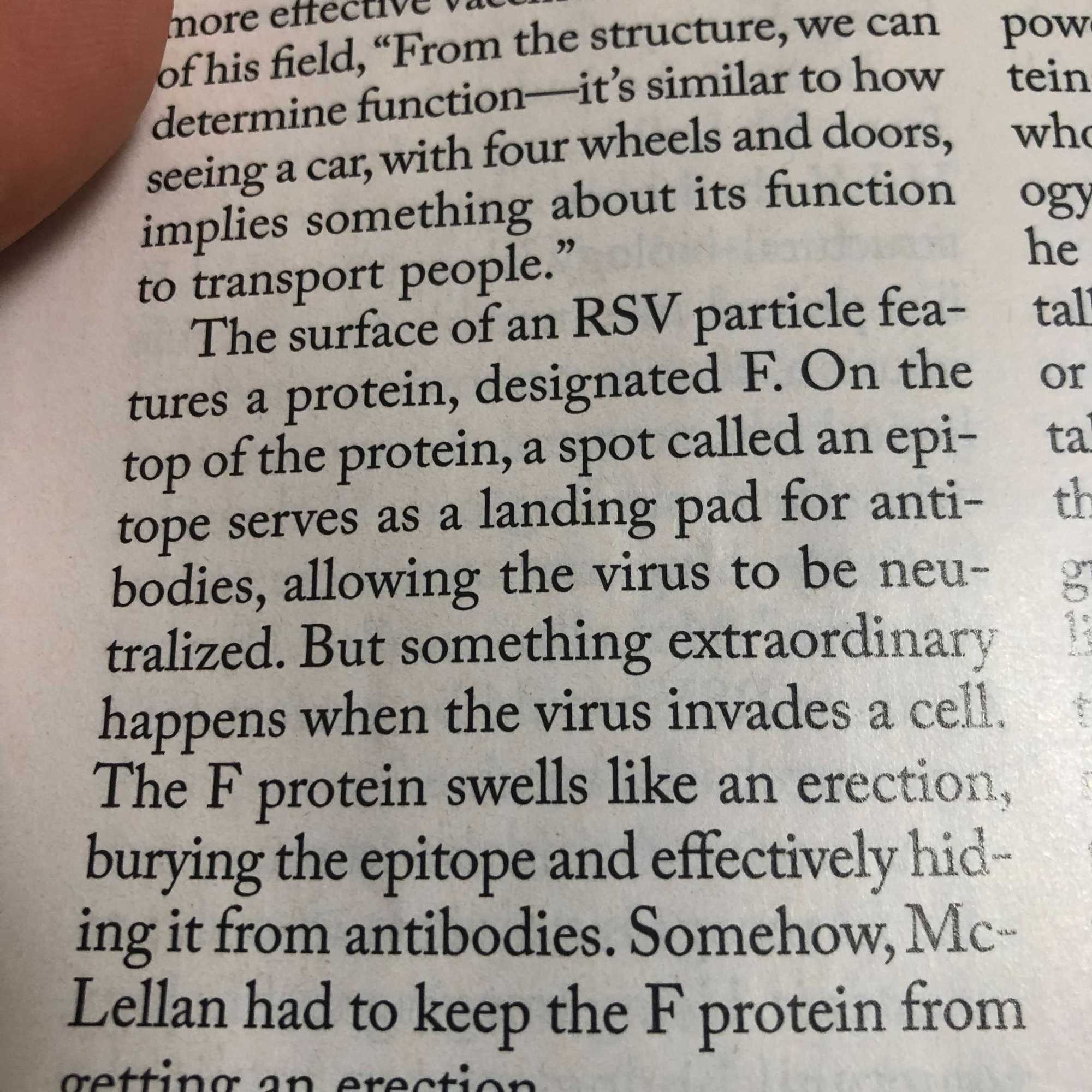
Wright is a master of stories that pitch the reader up against powerful, dark forces that need to be viewed up close to be understood: His famous piece on Scientology wasn’t just great reporting, but really got at the friction and bullying in the cult. I remember how eye-opening I found his profile of Ayman al-Zawahari, which is nearly 20 years old now, for fuck’s sake. This story has a few moments that stuck out to me: describing the covid protein spike as an erection that has to be suppressed, which my mind cannot unsee; his images of Deborah Birx driving cross-country; a metaphor of the pandemic as an unwanted dinner guest.

Telling a story like this is hard.
In journalism, “tick tocks” are stories that recount an event. The giveaway is that they focus on chronology, and lots and lots of New Yorker stories use the form, or tip their hat to it even if they aren’t always true tick tocks. The cliched opening: “On Wednesday 25 July, 2018, Brenda Hubbard, an astrophysicist in Brooklyn, was walking her dog down the street when an accident changed her life.” The New Yorker generally mixes the traditional tick tock style with the explanatory feature formats, and this story does the same—plus mixing in some personal stuff from Lawrence Wright’s own experiences of the pandemic. Working out how to tell this story must have been impossible: Wright says he filed more than twice the final length, and to be honest it feels like it’s been edited down. There are so many individual scenes and characters, and the chronology bounces backwards and forwards, and the personal moments sit a little oddly. It’s just too big a story for even the whole of the NYer feature well.

So perhaps some ideas are just too big for a single article, even a really long one.
Most of the memorable stories from and about the pandemic have done one of two things for me as a reader: they answered a burning question, or they helped me grasp what was coming next (Sometimes they do both.) I think that’s what Ed Yong did so well over at The Atlantic: he started asking questions that people were having and produced . (You can hear Ed talk a little about that in this episode of the Longform podcast.) Wright’s story was comprehensive, but to me it didn’t really do either of those things. If its motivating question was “what went wrong?” then it felt too big for a magazine article, even one that was more than 30,000 words. I could have devoured the whole book, each section expanded into a whole chapter, each character a fully-realized study. I’m not sure that’s anyone’s error, though: the pandemic itself is just a story too big to hold in your hand this way. (Even more so, I think than legendary previous single-issues like Hiroshima.)

It’s easy to get things wrong. This didn’t.
After reading Wright’s piece and feeling only partially satisfied, I then saw Nicholson Baker’s piece in New York on whether SARS-CoV-2 was created in a lab—which, by comparison, was wild-eyed and reckless. I was disappointed in that story and its presentation in ways I have yet to fully express. We’ve had such a lot of great journalism in this pandemic, truly, that Baker’s story—a piece of “Big, If True” memealism that cherry-picked its way to a vapid conclusion and pretended its shit didn’t stink along the way—reminded me that it’s hard to make it look easy.