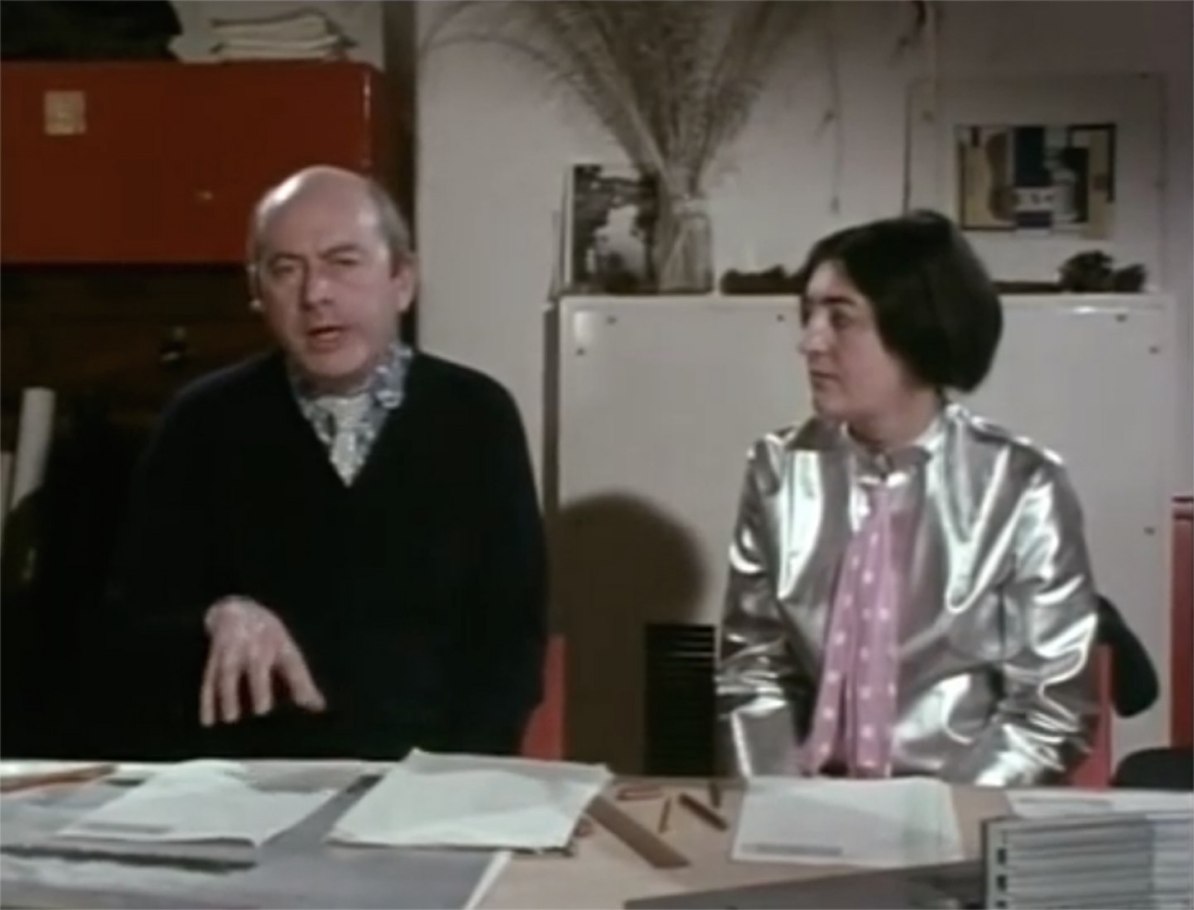
Alison Gill and Peter Smithson were just a couple of kids from Northern England when they met as architecture students at university in Durham in the 1940s. They had a lot in common: their obsession with buildings, of course, but also their politics and their vision for the future. Their attraction and mutual sympathies turned into love; enough to draw them together, to get married and have three children; enough to drive them to become leading lights in Britain’s architectural boom after the second world war.
The couple, who started working for the London County Council almost as soon as they became “The Smithsons”, co-opted a Swedish phrase and ended up coining the English term “New Brutalism”—an approach that took buildings and stripped them down with a mixture of hard-edged rawness and technocratic optimism.
Together the Smithsons helped shape British architecture for years, wrestling glass and steel and concrete, and getting into fights with people like Reyner Banham who really saw the world in quite a similar way, just not quite similar enough. What they didn’t make, they influenced: places like London’s Barbican and South Bank all have echoes of the Smithson’s beliefs—even if the buildings don’t officially carry their fingerprints.
⌘
Their philosophy was the look of my childhood, the die that cast so many municipal buildings and council estates across England in the 1970s and 1980s. Our town was built in the 1960s as “overspill” from London, and along with it came cut-price architectural echoes. I remember as a kid sitting in the waiting room of our local council office, wriggling in the hard moulded plastic chairs, seeing the concrete wet outside the door and the second hand of the clock bruising its way around the dial. I didn’t know who the Smithsons were, or how they worked together, but they created one of the most potent flavours of my childhood.
You can see their vision in this film by the poet B.S. Johnson (no relation) on their design for the Robin Hood Estate in East London.
What were the Smithsons outside “The Smithsons”? I’m not sure. But I do know that couples and creativity make for a fascinating subject.
⌘
We see so many examples of when two people come together and make things that are bigger and better than either of them can achieve on their own. Sometimes they make that work separately, but often together. Usually what lies between them is love, but not always. Some are romances, others are tragedies.
The Smithsons are my own parochial example, but what about Charles and Ray Eames? Look at Ted Hughes and Sylvia Plath. Burton and Taylor. Frida Kahlo and Diego Rivera. Or Lennon & McCartney, if you are happy with platonic partnerships. There is so much power in a pairing.
There are plenty of straightforward power couples of course; two people whose trajectories are so great and magnetism so tremendous that they each exert power and influence. But it’s not the counterparts I am interested in, it’s the co-conspirators.
Who better to help you express the inexpressable than somebody who knows you so intimately? Who else can unlock your ideas more than the person you are with most of the time? What is that magic that happened when Joan Didion and John Gregory Dunne got stuck into each other’s work, or when Jasper Johns and Robert Rauschenberg talked alone at night?
There are so many stories in it all, and so much to learn from.
Related reading:
 Start here