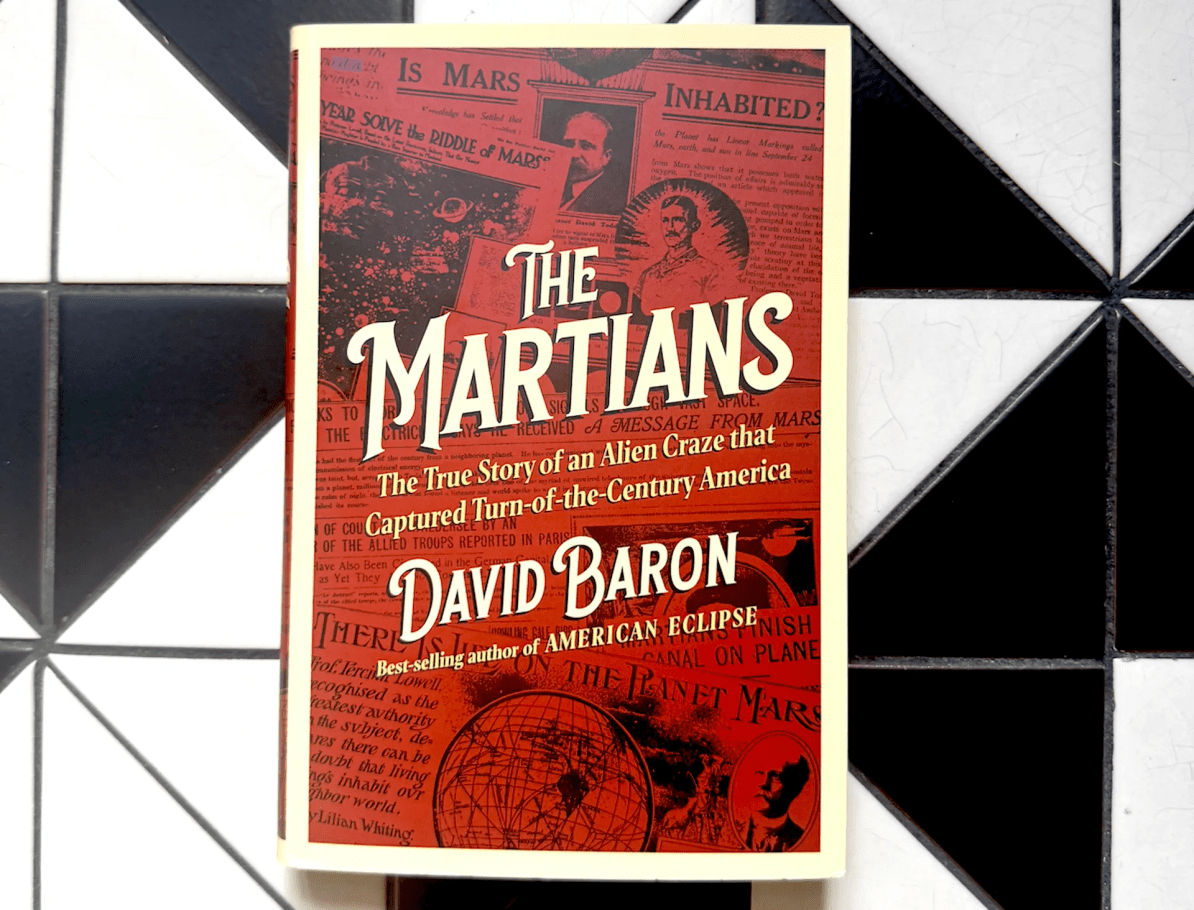
December’s Curious Reading Club book is The Martians: The True Story of an Alien Craze That Captured Turn-of-the-Century America by former NPR science editor David Baron—a rollicking read about the gilded age’s obsession with aliens, and the space-obsessed Boston brahmin Percival Lowell who made it happen.
David’s book looks at how the craze took hold, what it meant, and how it fell apart… and why we’re still obsessed anyway.

I was particularly taken by the concept of Mars as a planet full of benevolent, evolved beings—something we discussed during our chat.
One of my great finds when I was studying newspapers is this article from 1909 that I quote in my book that was headlined “Questions Mars Might Answer”. There was all this discussion about different ways you might communicate with the Martians. And what were the questions people had for Mars? Well, you would think it would be “how do you dig canals efficiently?” or “what's the best way to build a flying machine?”

No. The questions for Mars were the deepest, most existential questions: Where does the soul go when you die? What is the meaning of life? How can we prevent human suffering? These were the questions for the Martians. So, you know, it didn't surprise me that you know that people really wanted the Martians to exist because they might come save us.

... That totally surprised me, because the most famous piece of fiction to come out of that whole craze was H.G. Wells’ The War of the Worlds, which was published in magazines in 1897, and came out as a book in 1898—although most a lot of people are more familiar with the Orson Welles radio adaptation from 1938.

He [H.G. Wells] imagined the Martians coming here to take over our planet and to prey on us. And so I imagined that people must have been really scared of the Martians, and that this reflected some widespread view—but absolutely not. I found very, very few comments in the papers of people being afraid of the Martians. 99.9% were looking at the Martians as at least benign, if not actively a force for good here on Earth.
–David Baron
It was a really interesting conversation!
 Start here