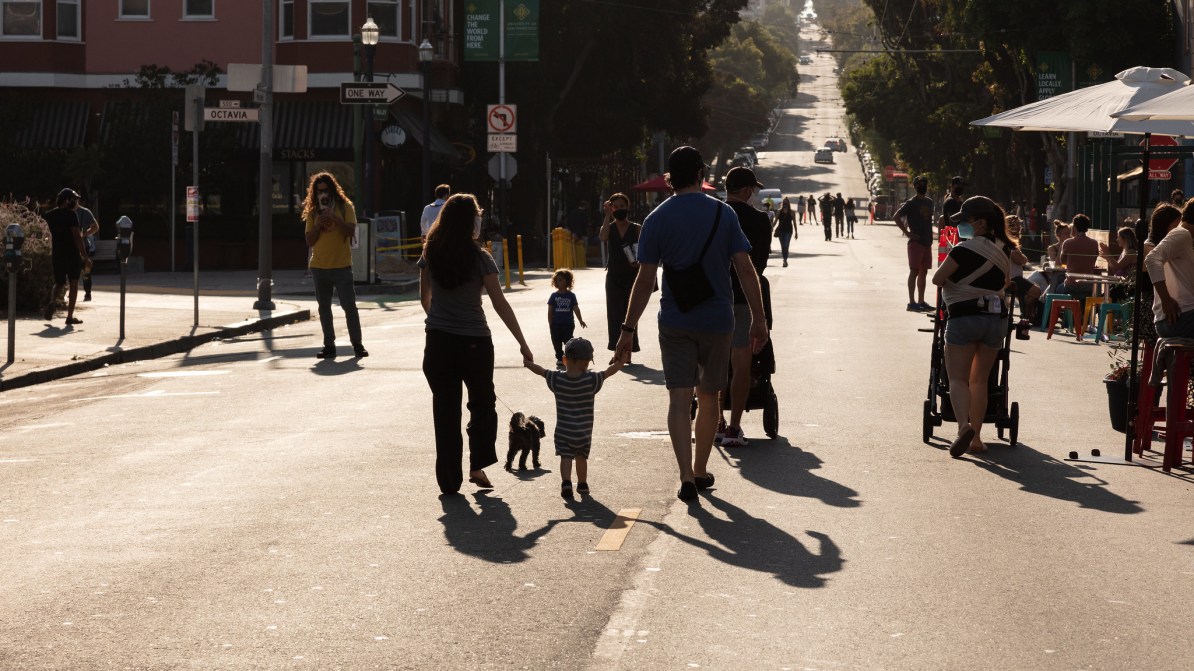
Hayes Valley is one of the neighborhoods that’s gentrified most since I first moved to San Francisco. What was a collapsed freeway encircled by shabby Victorians and empty lots is now a bougie strip of bars and glossy retail. Strapping young people fill the plaza. Dives have turned into destinations.
The main street, meanwhile, is stacked with retail outlets for stores you probably heard about first on the internet. Allbirds, Away, Warby Parker. You know the sort of thing. They’re all “tech” in the vaguest sense. Direct-to-consumer, web-based brands with aggressive internet advertising budgets. More than one got going on Kickstarter. Brooklinen (519 Hayes St) calls itself “the internet’s favorite bedsheets.”
Walking along Hayes Street is a little uncanny. It’s a series of podcast ads come to life.
⌘
Lots of the people in this area work in and around AI, many drawn to San Francisco by the latest promise of a gold rush. There are hacker houses, meetups, startups of all shapes and sizes. Some goons have even tried to relabel the area “Cerebral Valley.” Thankfully it hasn’t caught on.
The spiritual home of this movement is several neighborhoods away, at the offices of OpenAI—although the city is small enough that it only takes a few minutes to get there. The corporate drama that unfolded there recently is not my thing, but for those looking to know more, two recommendations. First is the Atlantic’s reported deep dive, which shows how the split inside the company is both wild and deep; second is this extremely good primer from Max Read. He not only dissects the issues and personalities, but also shows why OpenAI has come to occupy such an oversized position in the press.
There’s a presumption that there’s a deep philosophy behind the company, and really most of these efforts at artificial intelligence. (Molly White takes a crack at why that might be a problem.) I don’t know if it’s true, but I do know that for all the talk of generations with big ambitions and deep convictions, the same divides seem to be coming up again and again.
⌘
It brought to mind, in roundabout way, another of my mild obsessions. Fast fashion retailer Shein mixes combinatorial scale, automated listings, intent mining, cheap manufacturing and labor exploitation to produce a massive catalog of almost-instant products for anyone. It, not AI, feels like the closest thing to a cyberpunk dystopia that I’ve seen in a while.
Now, like those stores stacked shoulder to shoulder on Hayes St, Shein is going physical. Mia Sato, who has been doing an amazing job digging into the nooks and crannies of online culture at the Verge, went to the Shein store in New York—and found clothes, home goods, and… bizarro land.
Like Shein’s dirt-cheap clothing and accessories, much of the home goods for sale online feel similarly uncanny, like someone generated 10,000 product ideas and slapped a price on them. The bizarre, seemingly random pricing coupled with the truly perplexing product offering give it a Temu-like energy — where tube caps designed to look like a dog is shitting toothpaste ($2.60) are sold next to chicken drumstick-shaped smoking pipes ($4.30). The pricing is one of the company’s main draws for consumers.
It felt relevant, somehow: this idea of virtual spaces becoming physical locations. Shein is a digital marketplace, it’s now in the real world. OpenAI’s known for its GPT service, but behind the scenes it’s real people. These companies are staffed by real people, and real people do what they have always done, for the same reasons as ever. Money, survival, control—these are just as real today as they ever have been.
Because maybe that’s what it comes down to: the real world. For all the conversations about sustainability and rampant-capitalism-is-destroying-the-planet, Shein and others show that there are big differences between how a culture talks about itself and how it actually behaves. We talk about paying attention, but we all want to pay less. We talk about taking care, but we want it fast. We want change, but we like familiarity. And maybe that means we shouldn’t be surprised when the unreal distinction between the virtual world and the physical ones disappears—whether it’s in the makeup of neighborhoods, in the shops we visit, or in the human dramas we follow.
(Photo used under CC license from SF Planning)
 Start here