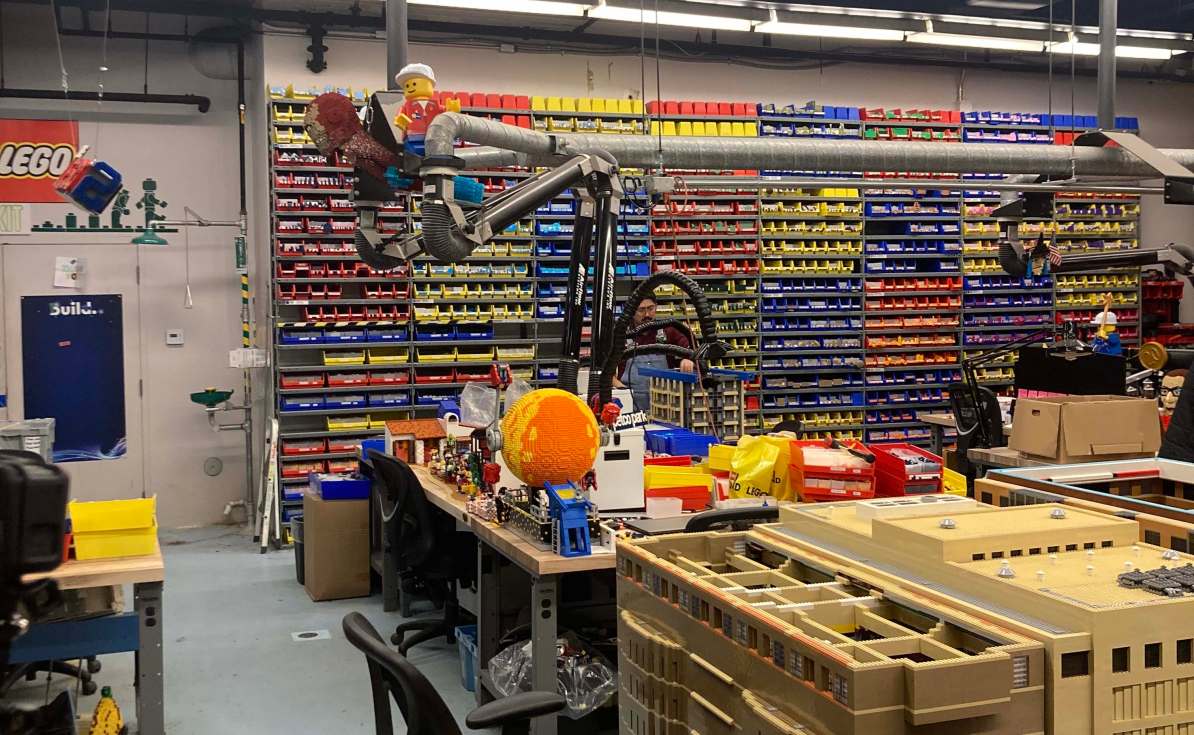
Earlier this year, we went to Legoland California for a family trip. We were lucky enough to get a VIP tour of the build room, the place where designers and architects build the displays. Inside, the tables were groaning with models-in-progress, and the walls were stacked with drawers containing every conceivable size, shape, and color of Lego brick. I was excited, of course, a fan in his element. We all were.
But I also had this sudden moment of realization: I don’t know how long it would remain. It was like a graveyard, a paean to plastic. How long would a place like this last? How long should it?
⌘
Take away my petrol, and I’ll drive electric. Bump up the cost of air travel and I’ll pay for my emissions—or stay home. Make plastic bags forbidden, and I’ll use paper. But take away my Lego bricks and you’ll have a riot on your hands.
I know a lot of people (parents, for the most part, but definitely not just parents) for whom Lego is their dirty little environmental secret. Their homes, like mine, are essentially playing host to an extra, unmentioned occupant: a massive blob of fossil-fuel derived plastic, that has been made palatable because it’s been chopped up into little 2×4 rectangles and peppered with studs.
Many of us were invested in Lego’s plan to go green by using recycled bottles for its products instead of oil-intensive ABS plastics. And many of us were disappointed when the company revealed that it was ditching the idea.
The reason they gave wasn’t financial cost, or time. It was, they said, because the switch would have actually created an even bigger carbon footprint. Says CEO Niels Christiansen:
“In the early days, the belief was that it was easier to find this magic material or this new material… that doesn’t seem to be there. We tested hundreds and hundreds of materials. It’s just not been possible to find a material like that.”
I applaud the honesty in some ways. No doubt they will get pelters for this. It would certainly be easier to say “we’re carrying on with this bottle plan” and just hope nobody looked too closely. Numbers are malleable, and enthusiasm can paper over many cracks, the PR problem can be something to deal with further down the line. But they seem to be admitting reality—a reality that many people and companies face. We’re so invested, so enmeshed, in an unsustainable practice that the obvious ways out are worse than staying still.
The real question becomes: what’s next? Lego says its plan is to make the ingredients of ABS a little more recycled or derived from plant-based materials; to move the needle a little more slowly, but perhaps more effectively.
But when your whole business is built on something environmentally pernicious, the reality is that perhaps there just is no good answer. It’s a fundamental challenge to what Lego is.
⌘
My mind went back to that Legoland visit. What will it seem like in a future without plastic? Will it be simply unfashionable or seen as totally inhumane? Is it bloodletting or a lobotomy?
In a few generations, I suspect society will look back at factory farming and see it as utterly baffling, barbaric practice. Why did we ever allow it to happen? Our children, and their children, will find it impossible to understand why we did what we did. Why we shared our information with advertisers. Why we used water so freely. Why we smoked cigarettes.
Perhaps one day we’ll look back at Lego and all that ABS and be shocked and ashamed that we ever liked it at all. If I tell my grandchildren about our visit to Carlsbad, maybe they’ll be repulsed by the idea. A whole theme park paying tribute to plastic—or a museum celebrating our own arrogance.
 Start here